
Marksmanship is the development of skills to hit whatever we aim at with certainty, at any range, within the effective range of our rifle. The skills required are numerous. It could be terrain, weather conditions, wind conditions: it does not matter. The only thing that matters is: I need to know with certainty that I can make the shot or not. If not, I will not take the shot.
Body Physiology
Understanding the body’s physiology must be understood before one sets up behind a rifle. It starts with our heart rate. This affects our whole body, especially the parts that touch the rifle, and hence the pattern of the crosshairs on the target.
Our heart rate directly affects our breathing and thus the hold on the rifle. With a poor hold, we will experience muscle fatigue faster causing the muscles to tremble. How we breathe can lower our heart rates.
The rule is: Relax! Be present with the target. Focus on steadying breathing to a normal relaxed state. Now we can clear our minds and focus on taking control of the shot.
We can also control fatigue. Our fitness can greatly influence our ability to deal with fatigue, but more important is a good shooting form by taking advantage of our body to better support the rifle. The forearm should be vertical under the rifle, minimizing muscle use.
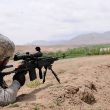
The prone position requires you to lie in a relaxed flat position, with toes out so your feet are flat on the ground, making it easier to control fatigue. Focusing on each body part, ensure you are minimizing the use of muscles to hold your position. If you using muscles, you will begin to shake. Practice finding the position that allows the least movement, yet still allows the flexibility to work the action on the rifle. Try all variations until you find the one you can hold for hours without tiring. Now, remember the position of every body part, how it feels and where the rifle is resting in relation to your nose, as it is crucial to your sight alignment. Practice until it becomes second nature. During the practice also focus on what would need to change in the event you cannot shoot from a prone position, as some situations will warrant a change in body position.
BONUS OFFER: Get your free shooting range targets to print at home!
Get your free targets to print at home!
Sight Alignment and Sight Picture
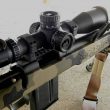
Without a scope, there are four factors to sighting consistently: the target, the front sight, the rear sight, and your shooting eye. The front and rear sites do not change, however, the distance from the rear sight to your eye can change and this must be avoided. When you find the right position for your shooting eye, remember it. Note the position of your eye and nose to the rifle. This applies to practicing with a scope. Ensure your eye comes into the same position every time you aim. Practice this until it becomes second nature as this will result in a consistent sight picture. Peep sights are better than leaf sights as it makes it easier to focus on the front sight using your peripheral vision. When you focus on the front sight the rear sight blurs and it is hard to tell with a leaf sight that you are centered.
Breathing
The correct way to breathe when shooting is to focus on the exhale. There is a point during exhaling when you feel you do not need to continue exhaling or start inhaling. At this point, you can hold you breathe for a second or two. When you inhale naturally, the muzzle drops, and when you exhale it rises again. The rise and fall of the muzzle, the sight alignment, sight picture, the trigger squeeze, all need to be synchronized with the “perfect point†in your breathing.
Trigger Squeeze
During a trigger squeeze, you will notice that at no point does the finger move straight back. The finger moves to the side and back. This results in a sideways pressure on the trigger that affects the muzzle. The tip of the finger is the part of the finger that moves the least. Use the part between the tip and the first joint. Ensure you are conscious of this so you eliminate all lateral pressure when squeezing the trigger. Squeeze the trigger by steadily increasing the pressure until the rifle fires. As you are focusing on the target, breathing and squeezing the shot should be a surprise every time. If not, you anticipated the shot and it results in a flinch.
Bullet Flight
The line of sight (LOS) is straight, but the bullet path (BP) is not. Due to gravity, the bullet starts dropping as soon as it leaves the barrel. The sight is adjusted to intersect the BP. The bullet drop rate is not constant as it is affected by both drag and gravity. The longer the bullet flight the more the effect of gravity. Drag has the most effect initially on the bullet path.
Advanced Marksmanship
Ballistic Coefficient
The drag deceleration of a bullet can be calculated precisely. A standard is calculated for the potential for a standard bullet and then other bullets are compared to this standard. This factor of a bullet compared to a standard bullet is known as the Ballistic Coefficient (BC). The BC is a measure of the efficiency of a bullet shot at the same muzzle velocity as the standard bullet. The higher the BC, the more resistant it is to the effects of the wind, the better it maintains velocity and the flatter it travels.
The BC, for a known muzzle velocity (MV), indicates the influence of drag on the trajectory of the bullet. The longer the shot, the more the time in flight, and the BC’s importance in deciding the drop. As the BC is defined at a specific MV, the higher the MV, the less time in flight. Hence, it is important to seek a higher BC for a bullet, but it needs to be considered in conjunction with the MV, energy, and the final velocity.
Altitude and Humidity
The density of the air is influenced by barometric pressure, humidity, and temperature. This density affects the drag on a bullet. A higher altitude does not necessarily mean a flatter trajectory of a bullet, as the temperature can be significantly colder. negating the difference in the thinner air. The dryness of the air will negatively affect the flatness in trajectory, as the molecular weight of dry air is heavier than the molecular weight of water.
There are numerous ballistics software programs available to calculate the differences for varying altitudes and humidity. Practice with your rifle and develop a table for different humidity and altitudes. Memorize the table and your shots will be more accurate, irrespective of the altitude or humidity effects.
Uphill/Downhill Shooting
Whether shooting uphill or downhill, the bullet drop does not change much. In both instances, the shot will appear to be high. As soon as the shot angle increases, the rifle hold or scope needs to be adjusted to compensate for the effect. The longer the range, the more the adjustment. Practice shooting at higher angles and then, for each angle, increase the range and develop a table for the bullet drop and the required adjustment. Once you have developed this table through practice, commit it to memory to ensure more accurate shooting in uphill/downhill situations.
Wind Effects
This is extremely important to shooting well. The best solution is to practice in all conditions and understand how to read the wind and the effects it has.
The wind direction is easily measured using the clock system. 12:00 is into your face and 06:00 is from behind. Even in strong winds, the vertical deflection is very slight and is only a few inches at a long range. Through practice, you can learn to adjust your sights or your rifle hold to compensate for the vertical deflection.
The lateral deflection is greater the larger the angle to the wind direction (1:00/2:00/3:00). The effects at 02:00 are the same as 10:00,4:00 or 8:00. Through practice, develop a table for the effects and the compensation required for 1/2/3:00 and then you can apply it to all the angles.
The most critical wind effect is that it is constantly shifting. This can be witnessed by watching the wind blow across a lake or a field. The wind direction and speed will not be constant from your position to the target, it will be constantly varying along with the distance to the target.
The time of day is important to the development of air movements. In the morning the land is cooler and gradually warms up causing convection currents to develop causing the air to move upwards. The inverse occurs in the afternoon through evening. Usually, in the late morning to the early afternoon, this convection effect is minimal, unless there is a weather system present.
It is critical to learn how to look for the signs of wind and its variability. It is visible in the effects on mirages, trees, bushes, fields, and water. Trees block the effects of the wind. Learn to read them to gauge the speed and direction of the wind over the path of the shot. The practice is crucial as all the complex formulas cannot replace practical experience.